
In 1962, William “Bill” Arms missed his own graduation. He was 22 and he left Tucson on his way to Paris to study with one of Picasso’s engravers. Graduation could wait. The world could not.
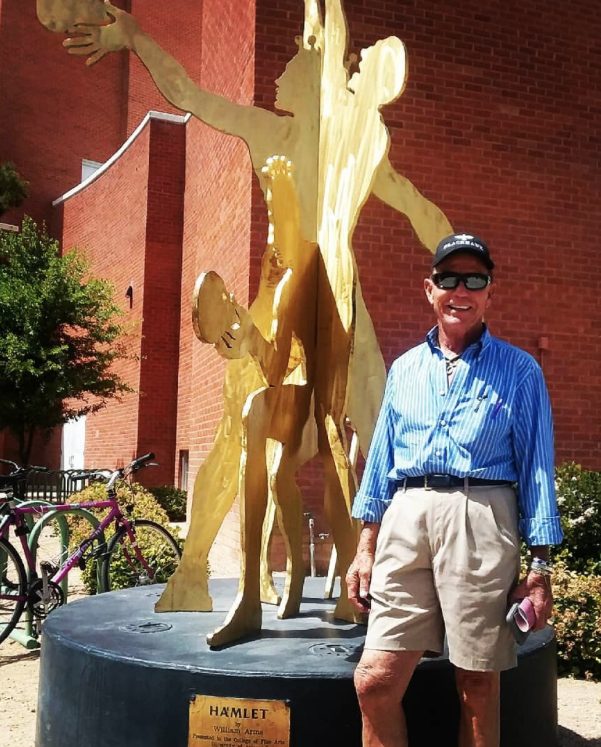
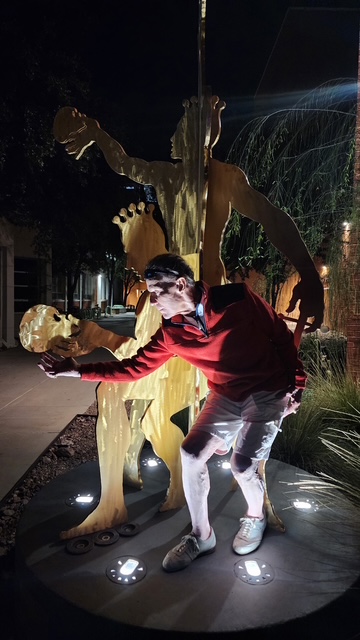
If you’ve walked past the Marroney Theatre, you’ve encountered Bill Arms’ work. He created the luminous bronze sculpture, “Hamlet,” a 12-year project.
This month Arms, now 86, returns to the University of Arizona campus to deliver the keynote address at the College of Fine Arts graduation convocation and to pick up that diploma at last.
Arms (BFA ’62, Painting & Sculpture emphasis) will tell graduates his inspirational, multifaceted life story of reinvention – from the international arts scene in Paris and New York City — where his studio was right next to Andy Warhol’s — to interior design in Palm Springs and a new chapter in Taos – and what he learned along the way.
“You have to stay flexible because the universe doesn’t have any straight lines in it,” said Arms. “I mean, in the long run, only your epitaph is written in cement, you know? Stay flexible and find your own truth.”
- Spring 2026 Graduation Convocation
May 17 | 2p | Centennial Hall
Three Careers, Three Worlds
Arms came to the University of Arizona on an engineering scholarship, based on his love of math, structure, and what he calls “what holds things up.” But painting and sculpting were always the draw. He found his way to the School of Art, minored in theatre arts, competed on the swim team, and left Tucson with a foundation he would spend decades building on.
“I loved this university. Wow. I love this place. It’s your first family, when you’re coming out of high school, this is your first family, so it’s kind of hard not to love this place.”
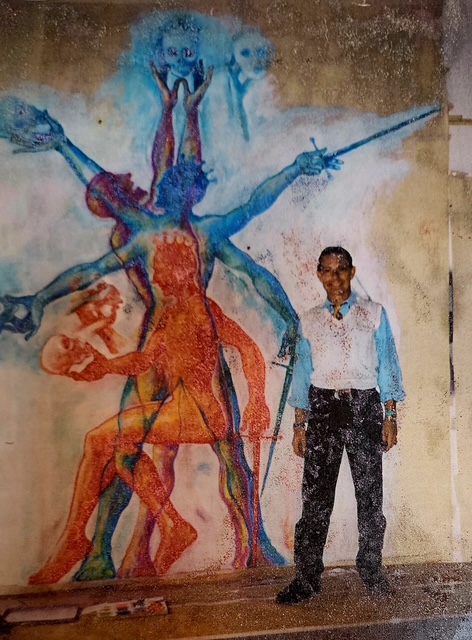
His first career unfolded in New York and Paris, where his sculptures earned him the most prestigious fine arts grants of the era, the Merrill Lynch, Pierce, Fenner & Smith grants, back-to-back, a feat that had never been done. He was moving in the orbit of Andy Warhol, Robert Motherwell, Helen Frankenthaler, and Rudolf Nureyev. A nomination for the American Academy of Arts and Letters was on the horizon.
Then a new opportunity appeared, and he took it.

Arms moved to Palm Springs, California, where he joined Arthur Elrod and Associates and became a defining force in the mid-century modern design movement — creating original work for high-design interiors, traveling worldwide to install it, and being featured in leading architecture publications.
When that chapter closed, he started over again, this time in Taos, New Mexico.
He immersed himself in the art world there before turning his attention to new creative territory entirely: film, music, and songwriting.
“Your career may not be linear,” Arms says simply. “Mine wasn’t.”
What He’ll Bring to the Stage
Arms’s address won’t dwell on nostalgia. He has things to say about the times we’re living in, the tools artists now have at their disposal, and what it means to be the kind of thinker a university education prepares you to be.

He’s thought carefully about what to pass on to this year’s graduates, and his message is both candid and clarifying.
On what this university gave him:
> “It gives you stuff you don’t realize until you’re older. It gives you permission to make mistakes and go on. It gives you permission to be great.”
On what a university is really teaching:
> “We don’t come here to learn how to do certain things. We come here to learn how to think — and thinking in and out of the subjects that you love and that you’re trying to discipline yourself in. That is where the magic was for me.”
A Long Time Coming
Arms has been a committed presence in the life of this university. He was a founding member of the Medici Circle, the College of Fine Arts’ philanthropic leadership group, and the “Hamlet” sculpture he created stands as a permanent testament to that connection.
Asked what it will mean to finally walk across the stage and receive his diploma, Arms laughed.
“I hope I can stay walking and not start floating over there. I’ll put some weights in my shoes.”