
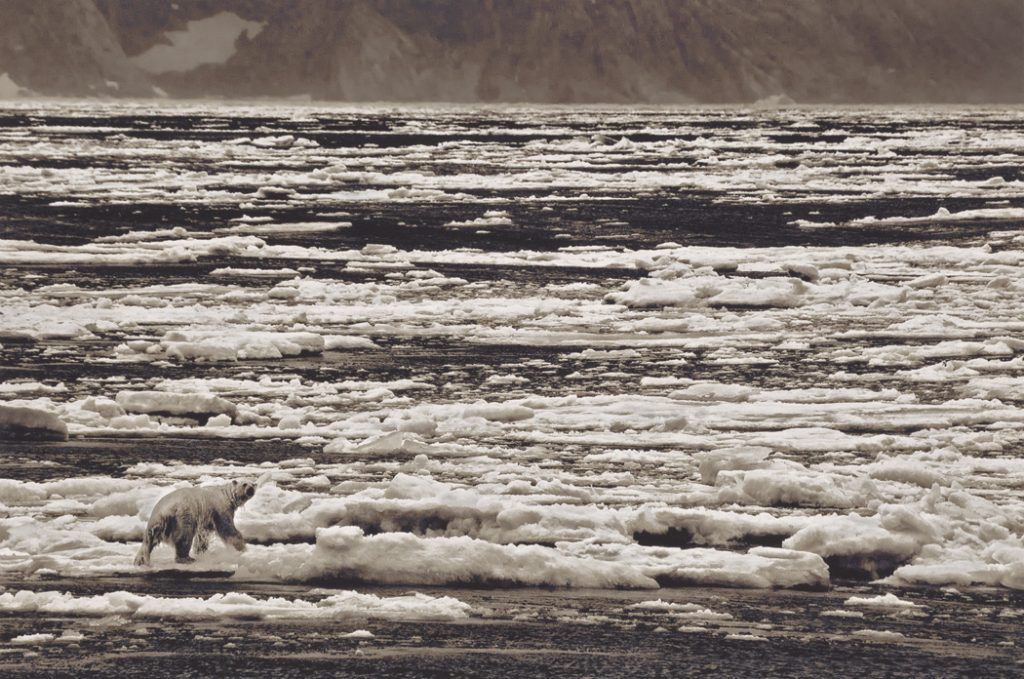
When “Animality: 100 Years of Photographs” opens at the University of Arizona Center for Creative Photography (CCP) on Aug. 8, visitors will meet a menagerie: sea lions saluting, a boy touching a calf’s nose, a rattlesnake draped across a man’s shoulders, a polar bear staring back from a melting shoreline.
More than 100 photographs and archival objects, drawn entirely from CCP’s permanent collection, bring together nearly 300 animals across 30 species — plus hundreds of bats — spanning photographic styles from journalism to street photography to contemporary art practice.
The exhibition, free and open to the public for visitors of all ages, runs through Dec. 12. Gallery hours are Tuesday through Saturday, 10a-4:30p.
“It’s a really wide range of ways of photographers thinking about presenting animals,” said Rebecca Senf, PhD, CCP’s chief curator. “The pictures are delightful. There are funny ones and cute ones and such a wide range of animals. However, the exhibition also touches on more serious issues including the ethical treatment of animals.”
- Center for Creative Photography | Animality: 100 Years of Photographs
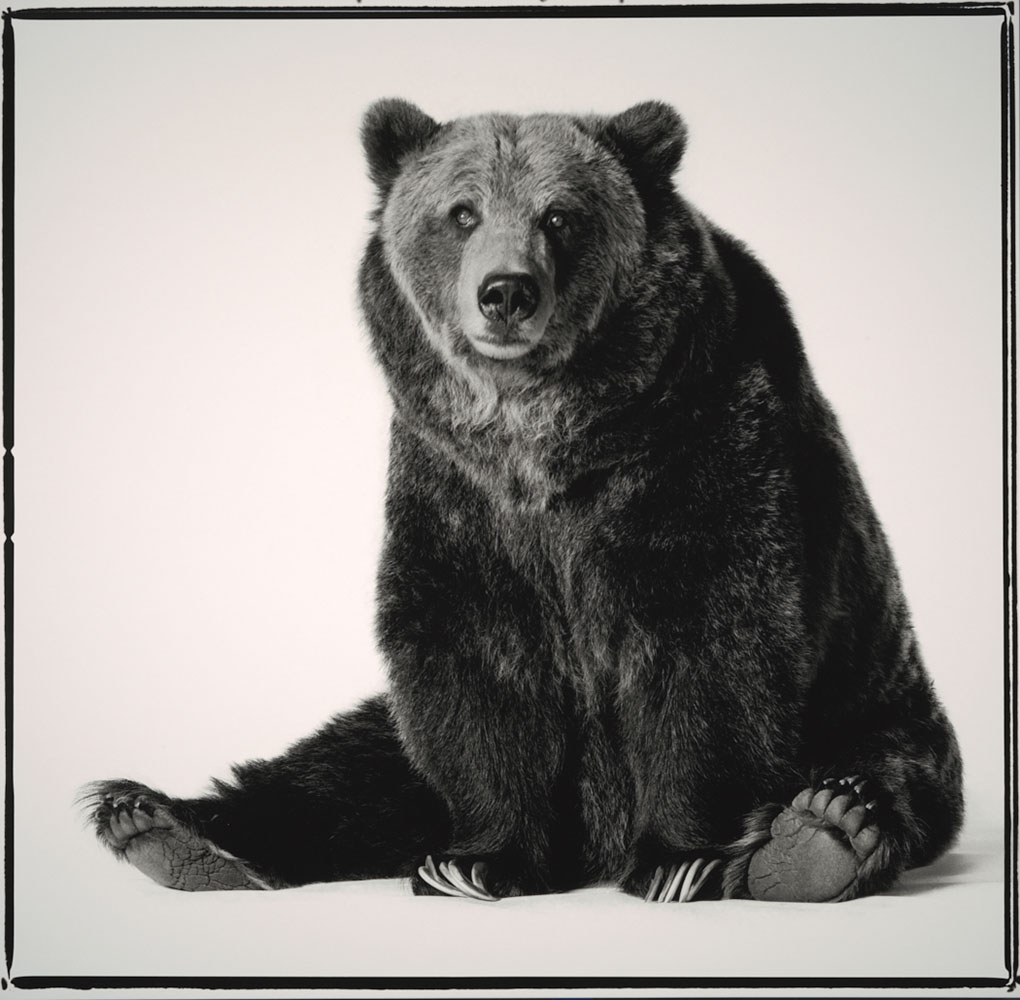
Center for Creative Photography, University of Arizona: Gift of California Academy of Sciences © Susan Middleton and David Liittschwager 2017.15.110
An unlikely curatorial partnership
“Animality” began with a curator looking for the right collaborators. Senf had wanted to build an exhibition around animals for some time, and around the same period she became aware of Human and Animal Interrelationships, a University of Arizona course co-taught by primatologists Netzin and Dieter Steklis in the School of Animal and Comparative Biomedical Sciences. The course, which has drawn as many as 1,000 students in a semester, examines how the domestication of animals — beginning with dogs roughly 40,000 years ago — has shaped the evolution of both humans and non-human animals, weaving together ethics, genetics, biology, psychology, archaeology and social science.
Senf reached out, and the professors were, in her words, all over it. It was Netzin Steklis who suggested working with a smaller subset of the class: the honors students. Seven were eventually selected — Dylan J. Brown, Maya Cervantes, Emma Charles, Charles Elliott, Emily Hogg, Emma Mireles and Shay Parchem — and Senf led them through a weekly seminar on exhibition curation during fall 2025.
“The course attracts students who are in the sciences, which was such a nice partnership, because these are students who had never deeply thought about what an exhibition was or how museums worked or the nuances of photography as an art form,” Senf said. “They were coming into it like blank slates.”
The students visited CCP in person to view the actual prints, which was a deliberate choice, Senf said, since “there’s a difference between standing in front of a giant photograph and standing in front of a tiny photograph.” Rather than asking the group to reach a consensus on a single theme, Senf had each student review more than 140 photographs from the collection and select five to seven favorites, then build a theme around their own choices and write labels. Senf built the exhibition’s structure around what emerged, adding two thematic groupings of her own for a total of 11 — among them explorations of captivity, touch, ambiguous animal expressions and the blurred line between human and animal behavior.
“Each student’s group has their name on it and their text and the pictures that they chose,” Senf said. “It’s a direct reflection of the things they saw that resonated with them and the ideas that they had about the pictures, based on what they were learning from the class.”
A second cohort of honors students from the course’s spring and fall 2026 sections — Derek Dewyer, Riley Weltmann, Lucy Waddell, Ariana Laguna-Garcia and Karsten Yin — also visited CCP’s print study room and contributed selections and video content that will be presented virtually in the gallery.

In the students’ own words
Walk the gallery and the students’ voices come through directly — each thematic grouping carries its author’s name alongside the label text they wrote to explain what drew them to those particular images.
- Dylan J. Brown, a nursing major, titled his section “Nature Under Our Thumb,” using pictures of harnessed horses and working elephants to raise questions about what humans owe the animals whose strength and instincts have been redirected toward construction, entertainment and research.
- Maya Cervantes, studying biomedical science, took a harder look at captivity in “Forced to Perform,” pointing to Rosalind Fox Solomon‘s photograph of a Central Park Zoo lion as an image of an animal stripped of his former glory by a life without choice.
- Emma Charles, a physiology and medical sciences major, built two groupings around physical connection and control. “Connecting Through Touch” gathers images of animals and humans in contact — including Imogen Cunningham‘s photograph of a boy and a calf — that Charles said capture the trust an animal shows when it lets a person get close. A second grouping, “On a Short Leash,” sits with the tension in that same relationship, using three very different photographs of leashed animals to ask whether a tether means safety, convenience or something more complicated.
- Charles Elliott, an optical engineering major, used “Ambiguous Expressions” to push visitors to look past a photograph’s surface — noting, for instance, that Ansel Adams‘ image of a hog farm at the Manzanar incarceration camp says nothing on its face about the Japanese American families forced to work it during World War II.
- Emily Hogg, a nursing major, focused her grouping, “Eyes Tell the Story,” on what an animal’s gaze can communicate on its own, without words. Some of the animals in her selection meet the camera directly, creating what she described as a moment of recognition and shared presence; others seem to hint at something the viewer has to imagine — fear, curiosity, joy or wisdom.
- Emma Mireles, a veterinary science major, contributed two groupings: “Center of Attention,” which looks at what draws the human gaze to an animal — sometimes the rarity of a creature like a coati, other times the simple commotion of pigeons scattering to eat — and “A Strange Everyday,” which uses a photograph of cattle resting in a busy street to show how an encounter that looks strange in one culture can be entirely ordinary in another.
- Shay Parchem, who is completing degrees in both biology and violin performance, used “Parallels — Deconstructing Anthropocentrism” to draw out the visual and emotional echoes between human and animal subjects as a reminder that humans, too, are animals. Included in this theme, a solitary dog photographed by Frances Murray that Parchem read as an expression of loneliness.
A century of photographers
The exhibition’s subtitle, “100 Years of Photographs,” reflects the range of its holdings: the earliest image dates to the late 19th century, and the most recent from within the last decade. Photojournalism, fine-art photography, social documentary and early 20th-century pictorialism all appear side by side.
Some of the photographers in “Animality” are among the most significant figures in 20th-century American photography, including Garry Winogrand, whose restless street photography helped define the era, and W. Eugene Smith, whose photo essays for Life magazine essentially invented the modern documentary photo essay. Andreas Feininger and Louise Dahl-Wolfe, both widely influential in their respective specialties of technical instruction and fashion photography, are also represented, alongside John Gutmann and Rosalind Fox Solomon. “Some of these photographers are known for their animal pictures,” Senf said. “Some, like Ansel Adams, took some pictures of animals because he took a lot of pictures, but he never set out to make pictures of animals in particular.”

One defining animal photographer
One photographer gets her own mini exhibit within the exhibition. A dedicated section is devoted to Ylla (Camilla Koffler, 1911-1955), whom Senf calls the defining animal photographer of her era — a Vienna-born artist who fled Nazi-occupied France for New York and built an international career photographing animals for magazines, advertisements and her own books, including several with “Goodnight Moon” author Margaret Wise Brown. Ylla’s archive is held by CCP, and the exhibition presents a slideshow of 100 of her photographs alongside portraits, correspondence, magazine tear sheets and other material from her career. She died at 44 while photographing an oxen-cart race in India, a story told in full in a companion feature published alongside this one.
More ways to look
CCP is inviting the public to become part of the exhibition, too: visitors can submit their own animal photographs for “Animals Everywhere,” a rotating community showcase displayed on a monitor just outside the gallery.
A full slate of programming accompanies the exhibition:
- SNAP (Social Night of Art and Photography) — Sept. 3, 5-7p, featuring a conversation with Senf and professors H. Dieter Steklis and Netzin Steklis from the School of Animal & Comparative Biomedical Sciences
- Community Day — Oct. 10, 10a – 4p, including a lecture by Pryor Dodge, author of “YLLA, The Birth of Modern Animal Photography”
- Artist Talk — Nov. 6, 5:30-6:30p, with Chicago-based photographer and interdisciplinary artist Colleen Plumb
- Book Club Discussion with Colleen Plumb — Nov. 7, 11a-noon
“Animality: 100 Years of Photographs” is on view Aug. 8 through Dec. 12 at the Center for Creative Photography. Admission is free.